
An arbitration organization is ready for the modern client when its arbitration case management process gives outside counsel fast access, reliable case visibility, clear communication and confidence that confidential information is properly controlled.
That readiness requires more than buying software. It requires technology, workflows and service standards that work together from case launch through closeout.
Strong arbitration case management should accomplish three things:
- The system centralizes case information.
- The workflow reduces administrative effort.
- The organization delivers a consistent experience.
Respected neutrals remain essential. But outside counsel also judge an arbitration organization by everything surrounding the proceeding: how quickly the matter begins, how documents are distributed, how deadlines are communicated and how problems are resolved.
The real test is not whether your organization has implemented a new platform. It is whether you are using a modern operating model that makes arbitration easier for the people using your services.
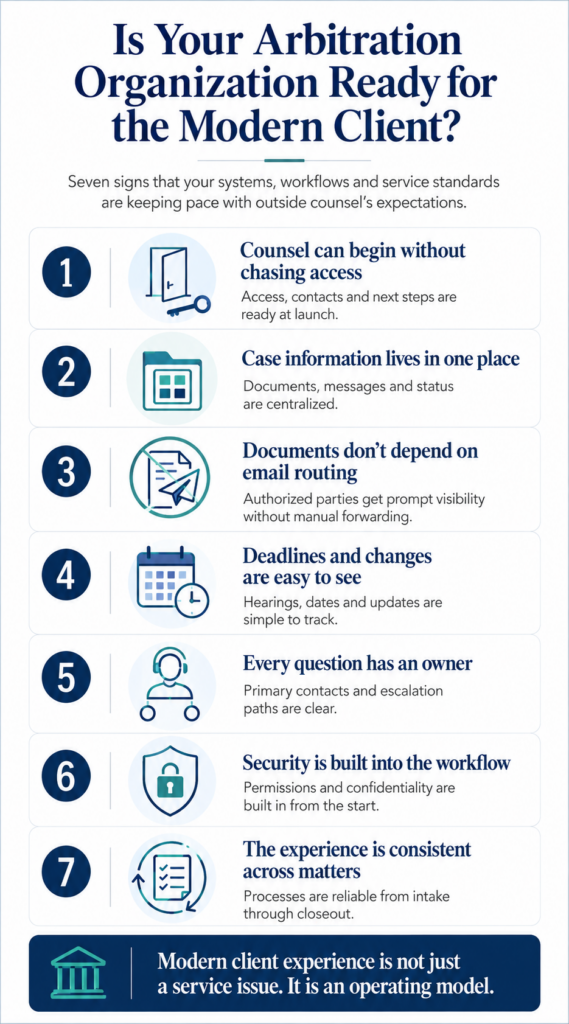
A modern client experience is built through a series of operational choices. Here are seven signs that an arbitration organization’s systems and workflows are keeping pace.
Your Neutrals May Be Excellent. What About Arbitration Case Management?
Neutral quality may bring outside counsel to an arbitration organization. The surrounding case experience helps determine what they remember about it.
Counsel team members interact with your intake process, case administrators, document system, calendar, communications and security controls throughout the proceeding. They notice whether information is easy to locate. They notice whether updates are dependable. They notice whether a question reaches someone who can take responsibility for it.
They also notice when the process simply works.
Effective arbitration case management connects people, information and activity across the life of the matter:
- Administrators coordinate the proceeding.
- Technology organizes the case.
- Service standards guide the client experience.
When those elements operate as one system, the administrative process feels controlled and predictable. Staff spend less time correcting preventable problems, while counsel spend more time focused on the dispute.
Client experience is therefore not separate from arbitration operations.
On the contrary: the client experience is what your organization’s operations produce.
That experience should be memorable. In a good way.
Would Outside Counsel Call Your Arbitration Process Modern?
A matter should not begin with a scavenger hunt.
Outside counsel should not have to request login credentials, search several messages for instructions or contact multiple employees to identify the correct person for a question.
A modern case launch provides the essential information before the matter becomes active:
- Appropriate access and permissions
- Primary contacts
- Notification information
- Service-list details
- Immediate next steps
- A clear location for case activity
The implementation framework for high-performing arbitration organizations recommends confirming parties, access permissions, service lists and notification settings before launch.
The practical test is straightforward:
Can outside counsel begin working without requesting information that should already have been provided?
Standardized onboarding creates more than convenience. It establishes control at the point when confusion is easiest to prevent.
The organization defines the process. The platform delivers access. Counsel begin the matter with clarity.
Is Your Arbitration Case Management Process Easier Than Email?
Email is useful. It is also a poor operating system for arbitration.
When documents, dates, notices and decisions are distributed across inboxes and attachments, counsel must reconstruct the matter each time they need an update:
- Is this the latest version?
- Did every authorized participant receive it?
- Was the deadline changed?
- Is another instruction buried in a separate thread?
- Has the document been accepted and posted?
Modern arbitration case management gives authorized participants one reliable source for current case information. Documents follow a controlled path. Permissions determine who can view them. Visibility does not depend on someone remembering to forward an attachment.
The implementation checklist recommends eliminating email attachments for case documents, managing submissions through a controlled portal and using simultaneous delivery with an audit trail rather than manual routing.
Proceed has also examined the confidentiality risks created by email-based arbitration workflows, including misdirected communications, compromised accounts and uncontrolled document access.
That examination points to one question every arbitration organization should ask:
Can counsel understand the current state of the matter without searching multiple systems?
The Modern Arbitration Client Expects Better Visibility
Outside counsel members bring expectations shaped by the other professional systems they use.
They expect current information to be available. They expect schedule changes to reach the correct people. They expect an urgent request to be treated differently from a routine question.
They do not expect to search a long reply-all chain to confirm a hearing time.
Modern coordination gives authorized participants a reliable view of deadlines, hearings, submissions and updates. It also establishes clear expectations for response times and document availability.
The implementation checklist recommends defining response-time standards by urgency level and measuring the time between a filing and its visibility to all authorized parties.
These standards create a simple chain of value:
- The organization defines response expectations.
- Case administrators apply those expectations.
- Outside counsel gain predictability.
Ask:
Can every authorized participant identify the current schedule without reconstructing an email thread?
And:
Does counsel know when to expect a response or meaningful update?
When those answers vary by administrator one conclusion emerges:
The organization may offer excellent individual service but it does not deliver a consistently designed client experience.
And don’t kid yourself: clients talk.
What Outside Counsel Notice About Arbitration Administration
Clients may never see your organizational chart.
But they can tell when it is getting in their way.
Outside counsel notice when they know exactly whom to contact. They also notice when a question moves from one person to another without anyone remaining responsible for the outcome.
A mature service model provides two kinds of ownership:
- A primary contact for routine case questions
- A clear owner when an issue becomes urgent, crosses teams or requires escalation
Operationally, this takes the form of:
- A primary point of contact for every matter
- A designated service owner responsible for standards, escalation and client experience.
This won’t solve every problem instantly, but it guarantees a problem never becomes ownerless.
Clients care about that.
The same principle applies to document workflows. Every manual handoff introduces another opportunity for delay, rework or confusion. Proceed’s article about document touches in arbitration administration examines how repeated routing, resending and verification consume staff capacity.
All of this uncovers a high-level question:
When something goes wrong, does counsel know who owns the problem, what happens next, and when another update will arrive?
A modern arbitration organization answers this question by making sure an employee receives the issue and can follow a process that defines the escalation path.
Most important, the client knows who is accountable.
How Modern Is Your ADR Case Management Software, Really?
Purpose-built dispute management software can have a profoundly positive impact on your workflow. But owning modern software is not the same as operating like a modern organization.
An ADR case management software platform that is inconsistently used, poorly configured or disconnected from staff workflows may simply create another place for counsel and administrators to check.
Here is how the software becomes valuable when it supports the operating model:
- Permissions are established at launch.
- Authorized users see information appropriate to their roles.
- Documents move through a controlled workflow.
- Messages, dates, and case activity remain organized.
- Audit log preserves a record of activity.
- Staff do not rebuild the process manually for each matter.
Security is central to that design.
The ICCA–NYC Bar–CPR Protocol on Cybersecurity in International Arbitration provides a framework for assessing information-security risks and selecting reasonable protective measures for individual proceedings.
One established method is role-based access control, through which permissions are assigned according to defined roles rather than handled informally each time information is shared.
The guiding principle should be simple:
The secure way should also be the easy way.
When security is built into the normal process, counsel spend less time requesting permissions, correcting distribution errors or wondering whether confidential information reached the wrong person.
Is Your Arbitration Case Management Keeping Up With Your Caseload?
Consistency does not mean every arbitration must be identical. Complex proceedings will always require judgment and flexibility.
What consistency actually means is that the operational fundamentals remain dependable:
- Access is established.
- Contacts are clear.
- Documents are controlled.
- Deadlines are visible.
- Escalations have an owner.
- Closeout follows a defined process.
Think of operational readiness as a documented case lifecycle in which every stage has an owner, a checklist, and a clear completion signal.
The final test of operations readiness is:
Could your organization take on more matters without creating more confusion, manual routing or administrative burden for counsel?
Modern Arbitration Case Management Is an Operating Model
Outside counsel does not see how many systems an administrator must check to answer a question. They do not see how many times a document is handled, or how often someone corrects a process behind the scenes.
And they shouldn’t have to.
They should only experience the result.
Modern dispute management technology can help achieve that result by centralizing participants, documents, calendars and collaboration. But implementing ADR case management software is only one part of the equation.
The larger objective is alignment:
- Technology supports the workflow.
- The workflow supports the administrator.
- The administrator supports outside counsel.
That is what effective arbitration case management looks like from the client side.
The question is no longer whether your arbitration organization uses technology.
It is whether the technology, people and processes work together so well that outside counsel barely have to think about them.
Contact us now to schedule an operational assessment to examine where technology, workflows and communication practices may be creating unnecessary friction for outside counsel.