

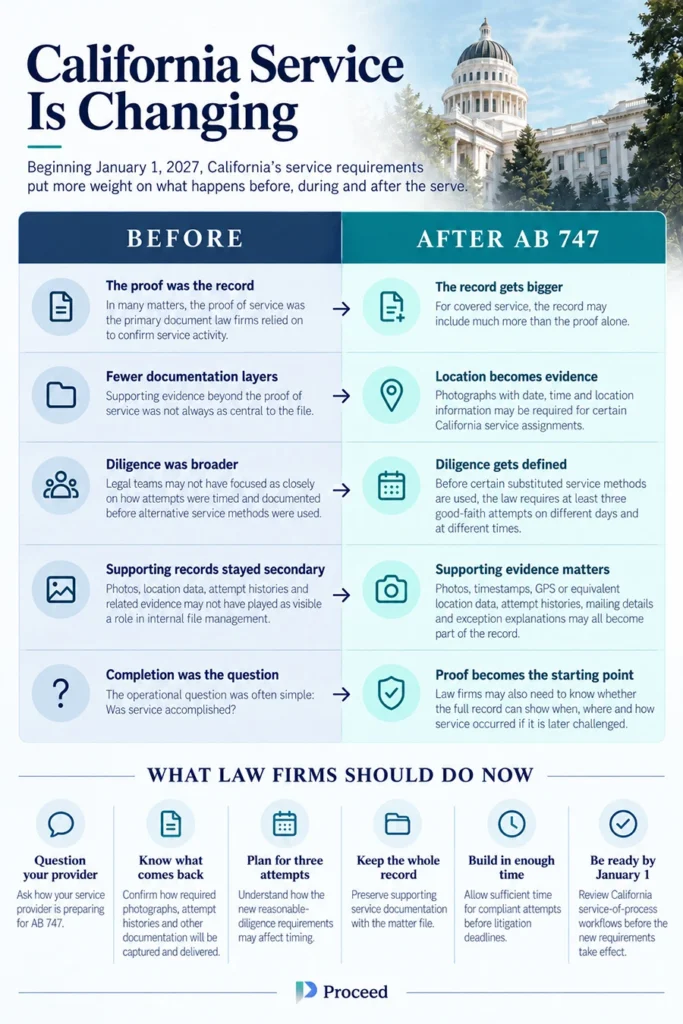
Beginning January 1, 2027, California AB 747 will change how certain service-of-process assignments must be documented and how reasonable diligence is established before alternative service methods may be used. For law firms, the practical impact is straightforward: firms should expect more detailed service records, including photographs, timestamps, location information and documented attempt histories, and should confirm that their process serving providers are prepared to meet the new requirements.
The law also increases the importance of preserving complete service records in case service is challenged later.
What Is California AB 747?
California Assembly Bill 747, formally known as the Service of Process Accountability, Reform and Equity Act, or SPARE Act, was signed into law in October 2025. Its relevant service-of-process provisions become operative January 1, 2027. Read the official AB 747 bill text
The law establishes new standards for documenting certain service attempts, defines reasonable diligence in specified situations, increases transparency around process-server registration and creates additional procedures for challenging defaults based on allegedly improper service.
For law firms, the most important takeaway is that the record supporting service will become more detailed and potentially more consequential.
What Should Law Firms Do Before January 1, 2027?
Law firms do not need to manage the field-level requirements themselves. They should, however, determine whether the process serving providers they rely on will be prepared to comply with AB 747.
Before the new requirements take effect, firms should consider asking whether their providers can:
- Identify California assignments subject to the new documentation requirements
- Provide photographs containing required date, time and location information
- Connect photographs and other supporting evidence to the correct service attempt
- Document exceptions when required photographs or location data cannot be obtained
- Schedule attempts in accordance with the law’s reasonable-diligence requirements
- Provide appropriate mailing and tracking information following substituted service
- Include required process-server registration information on proofs of service
- Maintain complete service records that can be retrieved if service is later challenged
This is also a good time to evaluate the provider relationship more broadly. Proceed’s E-filing & Service of Process Vendor Checklist provides a framework law firms can use when evaluating litigation-support providers.
Firms should also review their own matter-management and document-retention practices. Photographs, attempt histories, mailing information and other service records may need to remain associated with the matter rather than being treated as temporary operational information.
The goal is simple: when a service assignment is complete, the legal team should have confidence not only that service was performed properly, but that the supporting record can demonstrate what happened if questions arise later.
Which Service Assignments Are Affected?
The new photographic documentation requirements apply to certain service of a summons and complaint in California under Code of Civil Procedure sections 415.10, 415.20 and 415.45.
These provisions address personal service, substituted service and court-authorized posting in certain unlawful detainer matters. California Courts provides additional background on the state’s different methods of serving court papers and proof-of-service requirements. California Courts: Serving Court Papers
AB 747 does not impose the same photographic requirement on every document delivered or every type of service performed in California. Firms therefore should avoid treating the new law as a blanket requirement covering every process-serving assignment.
Instead, the applicable requirements will depend on the document being served, the method of service and the governing statute.
Photographs and Location Information Will Become Part of the Service Record
For covered service, proofs of service must include one or more photographs of the location of each completed or attempted service, subject to specified exceptions.
Each required photograph must contain a readable, automatically generated record of:
- The date
- The time
- GPS or equivalent location coordinates
The photograph must be taken as closely as practicable to the time of the attempt or completed service.
For service at a residence, at least one photograph generally must show the door or, if the door cannot reasonably be accessed, the entrance to the dwelling.
For service at a business, the photograph generally must show the door to the specific office or place of business or, if that door cannot reasonably be accessed, its entrance.
Importantly, the requirement concerns the service location, not a photograph of the individual being served.
For law firms, this means a completed service record may include considerably more supporting evidence than the traditional proof of service alone.
What If a Photograph or GPS Information Cannot Be Obtained?
AB 747 recognizes that standard photographic documentation will not always be possible.
If GPS, cellular or equivalent signal is unavailable at the location of an attempted or completed service, the service record must include a detailed explanation of why the required location information could not be captured.
A photograph is also not required when taking one would compromise the process server’s safety. In that circumstance, the attempted or completed service must still be documented, together with an explanation of the safety concern.
For the law firm ordering service, the important issue is completeness. If standard documentation is missing, the record should explain why rather than simply contain an unexplained gap.
AB 747 Defines “Reasonable Diligence” More Specifically
One of the most important changes for litigation planning is AB 747’s definition of reasonable diligence before certain forms of substituted service may be used.
Under the new requirements, reasonable diligence includes at least three good-faith attempts at personal delivery:
- On at least three occasions
- On three different days
- At three different times
In certain consumer debt actions, additional requirements apply, including an attempt at the defendant’s dwelling or usual place of abode when that location is known or reasonably identifiable. A similar three-attempt standard applies before posting in specified unlawful detainer matters.
This has a practical consequence for law firms: attempt timing matters.
Firms facing tight deadlines should build sufficient time into the service process rather than assuming alternative service can immediately follow several unsuccessful attempts.
For firms working across jurisdictions or managing a high volume of matters, using a provider with established service of process for law firms workflows can also help reduce the administrative burden of tracking jurisdiction-specific requirements.
Substituted Service Mailing Options Will Expand
AB 747 also modifies the mailing component of substituted service.
Beginning January 1, 2027, the follow-up mailing may be sent through the U.S. Postal Service using:
- First-class mail
- Priority Mail with tracking
- Certified Mail with return receipt requested
Service by this method remains deemed complete on the 10th day after mailing under the amended statute.
Depending on the mailing method used, law firms may receive additional tracking or return-receipt information. Firms should consider keeping that information with the related proof and service history.
Process-Server Registration Information Will Be Easier to Verify
AB 747 also makes process-server registration more transparent.
Beginning January 1, 2027, California county clerks must maintain publicly available registers of process servers. When a proof of service is signed by a person who is required to be registered, the proof must include the registration number assigned by the county clerk.
Law firms do not need to assume responsibility for managing process-server credentials. They should, however, have confidence that their provider is using properly registered personnel when required and that completed proofs contain the necessary registration information.
Why Complete Service Records Will Matter More
AB 747 also changes the procedures surrounding challenges to defaults and default judgments based on improper service.
A party claiming that a summons and complaint were not lawfully served may present evidence rebutting the process server’s return. When the statutory threshold is met, the party seeking the default or default judgment bears the burden of proving by a preponderance of the evidence that service was lawful.
For law firms, this is one of the strongest reasons to pay attention to AB 747.
Photographs, timestamps, GPS information, attempt histories, mailing records and documented exceptions are not merely administrative details. They may become part of the evidentiary record supporting the validity of service.
That means the service record can remain important long after the process server completes the assignment.
Unlawful Detainer Matters Require Additional Attention
AB 747 contains several provisions specifically affecting unlawful detainer matters.
In addition to the reasonable-diligence requirements governing posting, unlawful detainer complaints will be required to include information describing the method, date, time and location of service of the termination notice.
Law firms handling landlord-tenant litigation should therefore ensure that service information is captured accurately and remains readily available when the complaint is prepared.
Prepare Now for California’s New Service Requirements
AB 747 raises the documentation and accountability standards surrounding certain California service-of-process assignments.
For law firms, preparation does not require becoming experts in process-server operations. It does require knowing whether the provider handling the assignment has the systems, procedures and recordkeeping capabilities needed to comply.
Before January 1, 2027, firms should review their service-of-process relationships, understand how supporting documentation will be delivered and stored, and make sure California assignments allow enough time to satisfy the new reasonable-diligence requirements.
The practical question is no longer simply whether service was completed. It is whether the complete record can demonstrate when, where and how it was completed if that service is later questioned.
Proceed provides nationwide service of process supported by professional servers experienced in local requirements, along with centralized matter management and technology-enabled visibility. Contact Proceed to learn more about preparing for California’s AB 747 requirements and managing service-of-process assignments in California and nationwide.
This article provides general information and does not constitute legal advice. Law firms and legal professionals should consult applicable statutes, court rules and qualified counsel regarding the application of AB 747 to particular matters.
Sources
California Legislature, AB 747, Service of Process Accountability, Reform and Equity Act, 2025-2026 Regular Session.
California Code of Civil Procedure §§ 415.20, 415.45, 417.10, 417.40 and 473.2.